FRESH Lab: a community of practice to adapt housing to extreme heat
In 2024, Geres launched the FRESH programme (2024–2027) to develop affordable, passive thermal renovation solutions in secondary cities in Benin and Morocco. To embed this approach in a broader dynamic of knowledge-sharing and learning, Geres coordinates the FRESH Lab, both a scientific and technical advisory committee and an international community of practice. Supported by the Agence Française de Développement (AFD) and the Fondation pour le Logement des Défavorisés (FLD), the FRESH Lab connects field experience with international expertise to advance housing adaptation solutions for extreme heat.

Rapid urbanisation and heatwaves: a growing challenge for housing
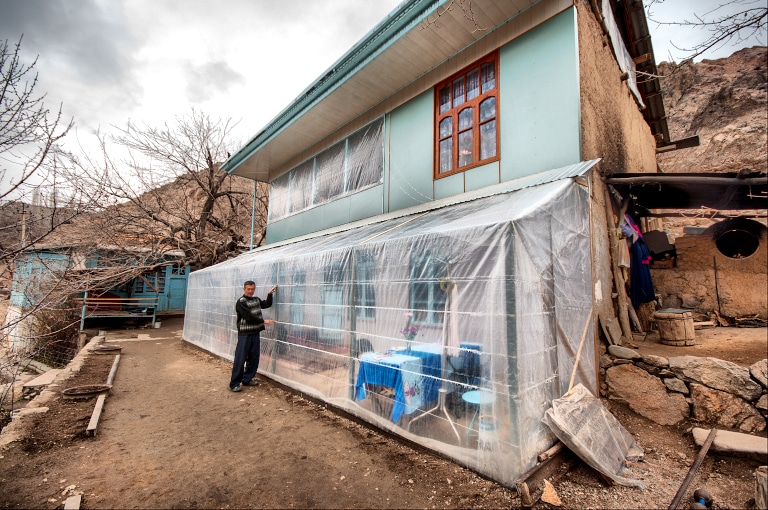
In many cities across the Global South, rapid urbanisation and intensifying heatwaves are exposing urban and peri-urban populations to increasing thermal discomfort. The gradual shift away from certain vernacular building techniques towards materials such as concrete or sheet metal can exacerbate overheating in homes.
Inside homes, heat stress particularly affects the most vulnerable people, including young children, older people, people with chronic illnesses and women. When households can afford it, adaptation often relies on active air conditioning, with consequences for energy costs and greenhouse gas emissions. In this context, developing passive, affordable solutions adapted to local realities is a major challenge.

Connecting local experience and international research to support scaling
Many civil society organisations, businesses and research institutions are already testing solutions to adapt housing to extreme heat. However, these initiatives can remain fragmented and have few shared spaces to exchange lessons, compare approaches and support wider dissemination.
The FRESH Lab seeks to address this challenge by creating an international space for knowledge consolidation, action research and co-creation around several dimensions:
- Performance and cultural acceptability of solutions: assess the technical effectiveness of materials and passive cooling measures, as well as their uptake by residents.
- Gender- and inclusion-sensitive data analysis: better document local perceptions of heat and the adaptation strategies of low-income households.
- Viability of economic models: explore financing mechanisms and support models that can make these solutions accessible to as many people as possible.
The FRESH Lab in action: sharing experience, generating knowledge and disseminating solutions
The FRESH Lab operates as a collaborative space to document and share lessons from the FRESH programme, implemented in Benin and Morocco, as well as insights from other Geres projects addressing housing adaptation to extreme heat, including CHILL in Cambodia and SENTRUM in Myanmar.
The community of practice is organised around a series of webinars and thematic sessions through 2027:
- Digitalisation and replication – June 2026 session: exchanges on tools and approaches to support scaling, including feedback from Build Change, Geres and IIED.
Watch the recording here :
- Capitalising on physical adaptation measures – second half of 2026: analysis of low-tech insulation solutions and local materials.
- Participatory thermal monitoring – to be confirmed: discussion of low-cost citizen science protocols to measure indoor thermal comfort.
- Scaling up – to be confirmed: exploration of market-linkage solutions and adapted financing mechanisms.

stakeholders
The FRESH Lab primarily targets stakeholders working on adapting the built environment to climate change: civil society organisations, researchers, building professionals, entrepreneurs, public institutions and specialised networks. By facilitating knowledge-sharing and the pooling of lessons learned, it helps strengthen these stakeholders’ capacities and, ultimately, improve the solutions available to populations exposed to extreme heat.
partners
Technical partners
To connect operational realities on the ground with scientific and technical expertise, the FRESH Lab is built around a multi-level governance structure:
The Benin Lab provides close technical follow-up, material testing and socio-anthropological validation. It brings together the Université d’Abomey-Calavi, through EPAC and POTEMAT, Architecture du Soleil / Atelier des Griots, IRD Benin and Eco-Bénin, the implementation partner.
The International Lab brings together a network of partners and experts from several regions of the world, including Geres, Build Change, Energy Saving Trust, IIED, Slum Dwellers International, ACHR, Habitat for Humanity / Terwilliger Center, MAJIRIS, CRAterre, IHS Erasmus University and Cbalance.
Financial support
This climate solidarity initiative receives financial support from: